Why immersive biofeedback training — not sit-back-and-relax VR — is the emerging category healthcare has been waiting for.
I spent years behind a news anchor desk, reading the day’s worst moments into a camera. What the camera never showed was what that does to a nervous system over time. I built Healium because I needed it — and then I met the Veterans, clinicians, and patients who needed it too. But this article isn’t about me, and it isn’t about Healium. It’s about a problem you face every day, and a category of tools that is finally catching up to it.
Here is the belief that drives everything we do: healthcare should not have to treat mental health blind. We measure heart rate, oxygen, and blood pressure in real time, on demand, with precision. Yet the nervous system — arguably the most expensive, most prevalent variable in the room — has stayed invisible. When you can’t see something, you’re left to guess. Your patients guess too. That invisibility is the real enemy. And a surprising amount of what gets sold as “VR therapy” does nothing to solve it.
The trap: not all VR is doing the same job
If you think “VR for wellness” means handing a patient VR goggles so they can sit back and relax in a pretty scene, you’re seeing half the picture and settling for the weaker half. A beautiful virtual beach is pleasant, but it is indifferent. It has no idea what your patient’s body is doing. It can’t respond, can’t confirm progress, and can’t teach anything. That is passive VR, and for a clinician who needs to see change, it is a dead end dressed up as innovation.
Writing in Psychology Today, neuroscientist and board-certified neurofeedback specialist Dr. Jeff Tarrant (Healium’s Chief Science Officer) draws the line precisely: passive VR relaxation is an environment that is “beautiful but completely indifferent to what your nervous system is doing.” The alternative he names is a genuinely different category — immersive biofeedback.
What is immersive biofeedback?
Immersive biofeedback pairs real-time monitoring of physiological data with a virtual environment that responds to that data. The distinction that matters: the patient’s own biometric signals drive what they see. Slow the breath, and the world responds. Shift toward a calmer physiological state, and the scene changes to reflect it. Physiology stops being a line on a graph and becomes something the senses can directly experience. As Dr. Tarrant puts it, immersive biofeedback closes the loop that meditation apps, flat-screen biofeedback, and passive VR each leave open — it “sees you, and it reflects this information inside an environment your senses actually believe.”
Passive VR vs. immersive biofeedback
Why the loop — not the headset — is the point
Researchers studying this combination point to three stubborn challenges in traditional biofeedback that immersion may specifically address: motivation, attentional focus, and transferring the skill into daily life (Lüddecke & Felnhofer, 2022, as cited in Psychology Today). A line moving on a monitor is abstract and takes training to interpret. A forest that visibly blooms as the body settles is immediate — it needs no translation. For the patient who finds eyes-closed practice frustrating or clinical biofeedback too dry to stick with, an environment that rewards regulation turns ‘homework’ into discovery. This is the difference between a patient telling you they feel better and a patient learning a skill you can both watch working.
What this changes for your practice
Healium translates neurofeedback (EEG brainwave activity) and biofeedback (heart-rate data from a wearable) into an immersive experience the nervous system can read at a glance. VR + biofeedback training, running together as one platform, replaces multiple tools you have to assemble yourself. For a care team, that produces something tangible:
- Something you can see, not guess at. Real-time biometric visualization replaces subjective self-report with something the patient and provider can both watch.
- A skill, not a dependency. A drugless tool designed to be reached for first — patients build the self-regulation to downshift their own nervous system.
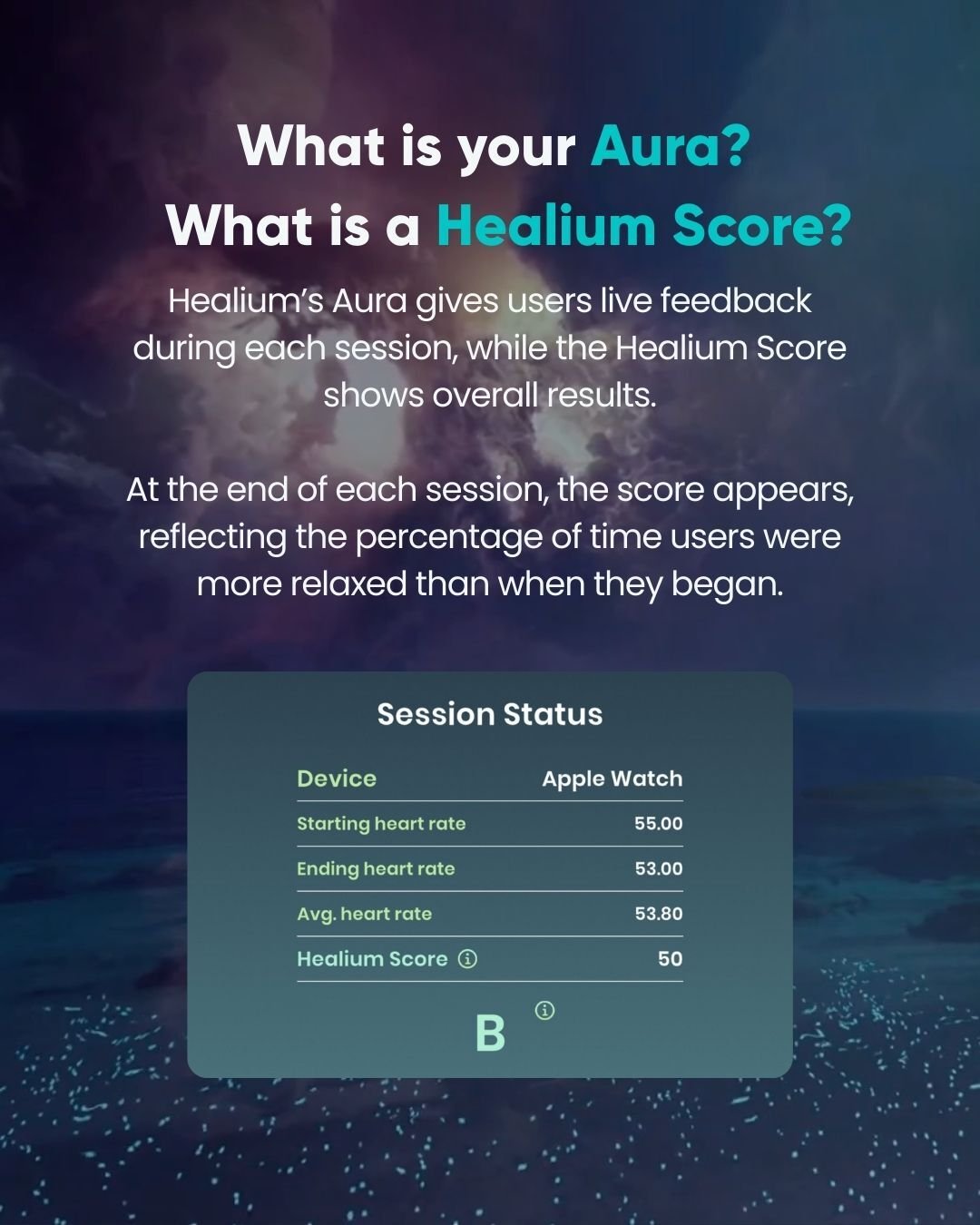
- A number to track. Each session ends with a score — a concrete data point that shows progress session over session.
The authority behind the category
This is a young field, and it deserves honest framing. The research base for VR biofeedback is still growing, but early controlled studies are encouraging, and the direction of the evidence favors richer, more immersive feedback (Kothgassner et al., 2022; Galang et al., 2025, as cited in Psychology Today). Healium’s own place in that literature is specific: in multiple peer-reviewed studies, including work published in Mayo Clinic Proceedings and Frontiers in Psychology, subjects showed anxiety reduction or mood improvement in as little as four minutes. Healium is a registered FDA Class II 510(k)-exempt biofeedback medical device, and the U.S. Department of Veterans Affairs has deployed thousands of Healium kits — a signal that a major federal health system trusts the platform at scale.

The stakes of standing still
The cost of the status quo is quiet but real. Patients who can’t tell whether their practice is working tend to give up before the benefit arrives. Providers keep carrying the weight of caring for what they cannot see. The opportunity is the mirror image: give patients a nervous system they can finally see, and give yourself a visualization for the one vital sign healthcare has always had to guess at.
Frequently asked questions
Is immersive biofeedback the same as VR therapy?
No. Most “VR therapy” is passive — a fixed environment that doesn’t read the patient. Immersive biofeedback training visualizes physiological signals and lets those signals shape the environment in real time.
What do Healium's wearable integrations measure?
Neurofeedback (EEG brainwave activity) and biofeedback (heart-rate data from a wearable), visualized as an immersive ‘aura’ that responds as the patient self-regulates.
Does Healium replace therapy or clinical care?
No. It is a self-management and relaxation-training tool used alongside professional care, not a replacement for it.
Is there evidence?
Healium has been evaluated in multiple peer-reviewed journals, including Mayo Clinic Proceedings and Frontiers in Psychology. The broader immersive-biofeedback field is young but growing.
Source: Tarrant, J. “What Is Immersive Biofeedback?” Psychology Today, July 12, 2026. Studies referenced therein include Kothgassner et al. (2022), Galang et al. (2025), and Lüddecke & Felnhofer (2022).